
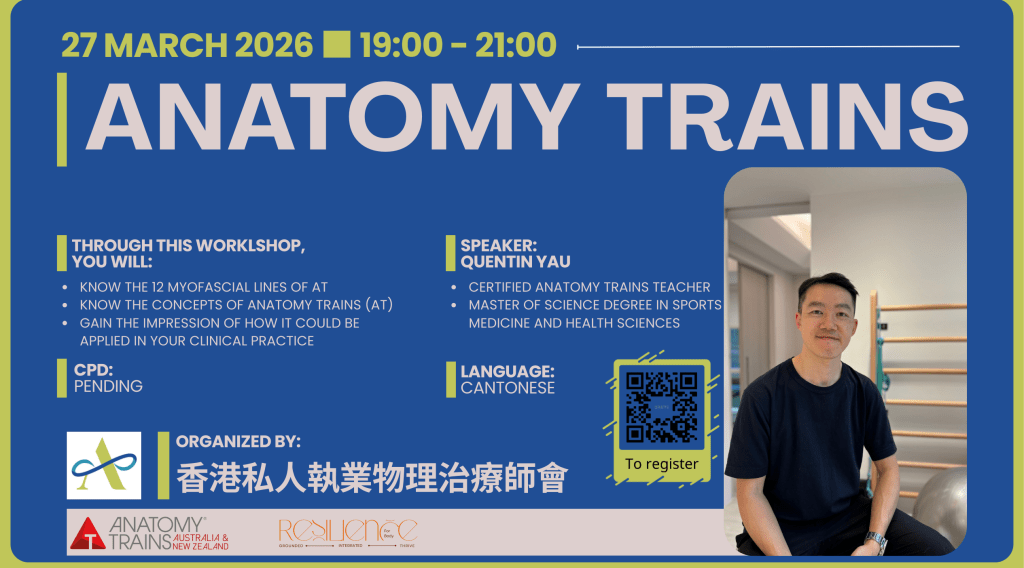
Date: 27 March, 2026
Time: 19:00-21:00(GMT:+8)
Speaker: Quentin Yau
Venue: 毅力醫護健康集團
Address: 彌敦道363號恆成大廈16樓1603(電梯15樓再上一層)
Language: Cantonese 廣東話 (Handout will be provided only in English in electronic format)
Participants: Physiotherapists and physiotherapy students
Prerequisites: None
Tuition: FREE.
Register NOW
About the event
As physiotherapists, we are trained to analyze movement dysfunction through a lens of isolated structures—muscles, joints, ligaments, and neural pathways. This reductionist model has served us well in diagnosing and treating specific conditions. But in clinical practice, we often encounter patients whose pain and dysfunction don’t fit neatly into a single-muscle or single-joint paradigm.
In this workshop, we will explore Anatomy Trains—a myofascial meridian system developed by Tom Myers that maps how muscles and fascia link together into functional, body-wide lines of tension and transmission. This framework bridges the gap between local symptomology and global postural and movement patterns.
After this introduction workshop, you will:
- Understand the myofascial web and its role in force transmission, proprioception, and compensatory patterning.
- Explore the 12 myofascial meridians—including the five core lines, four arm lines, and three functional lines—and their relevance to common clinical presentations.
- Learn BodyReading™, a visual assessment tool that helps identify dominant lines of strain and imbalance in posture and gait.
- See dissection-based evidence of these continuous fascial chains and their practical implications for treatment planning.
- Discover Anatomy Trains Structural Integration (ATSI), a systematic approach to balancing these lines through manual therapy and movement re-education.
- Connect theory to practice with case-based examples, such as rib cage alignment, scapulohumeral rhythm, and lumbo-pelvic stability.
This is not about replacing what you already know, but about integrating a holistic model into your clinical reasoning—one that respects both the integrity of individual structures and the intelligence of the whole system.
Whether you work in orthopedics, sports, neurology, or chronic pain, this framework offers a powerful way to address the “why” behind recurrent dysfunctions and to create more sustainable outcomes for your patients.
Let’s begin this exploration of the connected body—where local symptoms often have global solutions.
身為物理治療師,我們習慣透過個別結構——肌肉、關節、韌帶與神經路徑——來分析動作功能障礙。這種化約式的模型在診斷與治療特定問題時非常有效。然而在臨床實務中,我們常遇到病人的疼痛與功能失調,無法簡單歸因於單一肌肉或關節問題。
工作坊將帶我們探索解剖列車——這是由 Tom Myers 發展的一套肌筋膜經線系統,描繪肌肉與筋膜如何連結成功能性的全身張力與力量傳導路徑。此架構能幫助我們理解局部症狀與整體姿勢及動作模式之間的關聯。
經過今次工作坊之後,您將:
- 理解肌筋膜網及其在力量傳導、本體感覺與代償模式中的角色。
- 探索 12 條肌筋膜經線——包括 5 條核心線、4 條手臂線與 3 條功能線——並了解它們與常見臨床表現的關聯。
- 學習 BodyReading™(姿勢評估),一種視覺評估工具,幫助識別姿勢與步態中的主要張力線與失衡模式。
- 觀摩解剖實證,了解這些連續筋膜鏈的存在及其對治療規劃的實用意義。
- 認識解剖列車結構整合,一套通過徒手治療與動作再教育來平衡這些經線的系統性方法。
- 透過案例分析將理論連結至臨床實務。
這並非取代您已有的知識,而是將一個整體性模型整合到您的臨床推理中——一個同時尊重個別結構完整性與整體系統智慧的框架。
無論您專精於骨科、運動復健、神經復健或慢性疼痛治療,此架構都能提供一個有力的視角,去探究功能失調反覆發生的「根本原因」,並為您的病人創造更持久的療效。
讓我們一同展開這段探索人體連結性的旅程——在這裡,局部症狀往往需要整體性的解決方案。
 Resilience For Body